Featured Post Today
print this page
Latest Post
Tampilkan postingan dengan label how. Tampilkan semua postingan

How to value a mining company


By Paul van Eeden

I received an interesting question about company valuations from one of my newsletter subscribers that I thought I would address as a Commentary. It is a multi-part question that will take more than one Commentary to address; this week is part one: Valuing Mining Stocks.

Mining is a finite business. Mineral deposits contain a certain amount of ore and when that ore is mined out the deposit is depleted, no matter what you do or wish.

That is in stark contrast to say, an auto parts manufacturer, who can adapt to new demands and specification changes and (hopefully) stay in business for many decades. When you value an auto parts company, you can compare the companys price to earnings, price to cash flow, operating margin and net profit margin (among other things) to the companys peers to assess whether the stock in question is relatively cheap, or relatively expensive. You can also get a sense of whether the stock is cheap or expensive in an absolute sense by looking at the book value per share and comparing things like the profit margin and dividend rate to prevailing interest rates. But, embedded in all this (except book value per share) is the implicit assumption that the earnings and cash flow are for all intents and purposes infinite. When you are dealing with a business that can be reasonably expected to continue in a similar fashion for many decades, earnings per share, cash flow per share, dividend rate, etc. are meaningful. That is not the case with mining.

Take a hypothetical mining company that has only one mine as an example. Let us assume that mine is going to produce for another five years before the ore will be depleted. Now, let us say that the companys price to earnings ratio is ten. A hypothetical auto parts manufacturer also has a price to earnings ratio of ten. Based on just this one metric, we cannot differentiate between the two stocks. Let us also assume that the prevailing ten-year interest rate is five percent.

This means that you can invest your money in a ten-year bond and earn five percent per year while taking relatively little risk (other than the risk of interest rates rising, which could negatively impact all the investments under consideration and is therefore not considered).

The auto parts manufacturer has a price to earnings ratio of ten. That means for every dollars worth of stock you buy, you expect to earn ten cents, or ten percent, in earnings. It does not really matter for our purposes whether those earnings are retained by the company or paid out as a dividend since, either way, the earnings accrue to the benefit of shareholders. Furthermore, you can reasonably assume that the auto parts manufacturer is going to be in business for several more decades and, because you have done lots of due diligence, you can also assume that the future earnings are likely to be the same as the current earnings. So, if you buy the auto parts stock, you will earn ten percent per year as opposed to five percent on your bonds. The auto parts stock is probably riskier than a bond; however, if you can make twice as much money it might be tempting.

Then you look at the mining stock and notice that it, too, has a price to earnings ratio of ten and, therefore, you can also make ten percent a year if you bought that stock. But you would be wrong. The mining companys mine only has a five-year life ahead of it. So, if it has a price to earnings ratio of ten it means that for every dollar of stock you buy you get ten cents in earnings. But the earnings are only going to last another five years, so your total earnings per dollar of cost will only be fifty cents — - half of what you paid for the stock — - and then the mine is depleted. Thats why comparing a mining stock to other investment opportunities on the basis of price to earnings, price to cash flow, or dividend yield is complete nonsense. It is just as futile to compare mining stocks to each other based on these metrics because mining companies have different mine lives in their operations.

The only reasonable way to evaluate a mining company is to look at the net present value of the potential future cash flow, discounted at an appropriate discount rate. You have to take into account not just the cash flow that the mine(s) is generating, but also sustaining capital costs (including future exploration and development costs) associated with keeping the mine in production. Assuming you can derive a suitable cash flow model for each mine that a company owns you can then calculate the net present value of future cash flow by using an appropriate discount rate to represent the geological, political, social and financial risks. If you sum all the net present values together, add any other assets on the balance sheet and subtract any debt, you will arrive at the net asset value per share. In a rational world you would expect to pay no more for a mining stock than its net asset value per share — - how do you expect to make money if you consistently pay more for stocks than what they are worth? But, in the real world, mining stocks almost always trade for more than the net asset value of their constituent mines, and for a good reason.

Mining stocks also offer leverage to commodity prices. Take a gold mining company as an example. Assume we have a company that mines gold for a total cost of $400 an ounce, and let us pretend the gold price is $500 an ounce. The net present value of the mine would be calculated based on the $100 margin. If the gold price increases by 20% to $600 an ounce the net present value of the mine will double, since the margin would now be $200 an ounce. Thus the value of the company increased five times more than the increase in the gold price. Most people buy mining stocks because of this leverage.

What should be immediately evident is that if you pay more for mining stocks than what they are worth, on the speculation that the price of the underlying commodity will increase, you are merely gambling on the commodity price. Fortunately there is a way to quantify the premium that one should pay for a mining stock to incorporate the leverage it has to the underlying commodity price. There is a formula called the Black-Scholes Model that can be used to calculate the "option" value of a mining stock [Editors note, you can find more information on the Black Scholes model and further links at http://en.wikipedia.org/wiki/Black-Scholes ]. What should be done is to calculate the discounted net present value of the all the companys mines and then add the "option value" of the mines as calculated by the Black Sholes formula to obtain a more realistic asset value per share. By adding the optionality of mining shares to the net present value of the mines themselves we can account for the fact that mining shares trade at a premium to their net asset value because of their leverage to the underlying commodities.

If you calculate the net asset value of a mining stock as described above you will get a result that can be used to compare different mining companies to each other, and mining companies to investments in other sectors. Unfortunately, very few mining analysts employ the Black Sholes model to calculate mining net asset values, so for most people buying mining stocks really comes down to blind speculation on commodity prices.
0 komentar

How to setup install an expert advisor in MT4

Many people who are new to automated forex trading are puzzled by installation issues regarding the expert advisors for the metatrader platform. This easy to follow graphical guide will show you the simple steps necessary to setup an expert advisor for the metatrader 4 platform.
-
1. Download your expert advisor file and indicators (if the ea needs any custom ones). These are either ex4 or mq4 format files, depending on if they are a source or a binary (precompiled file). There is no difference between these two classes as far as installation and usage goes.
-
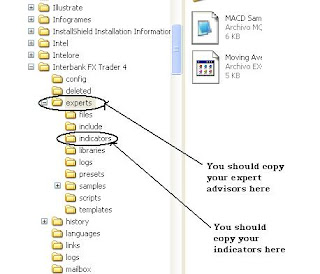
2. Copy your expert advisor files and indicator files to the corresponding directories. As it is shown in the following picture. Keep in mind that this directories are located under your metatrader installation path and that metatrader should not be running at this point.
-
-
3. You should now open up metatrader. Open up a chart with the timefrime and currency pair in which you want to run the advisor. Now simply drag and drop the expert advisor from the navigator window as shown in the next picture.
-
4. Now you need to check the live trading dialogue and change any settings you would like to modify on the expert advisor, as it shown. Also remember to click on the expert advisor button on the upper section of the program to allow trading.
-

-
5. Now you should check that the expert is running. A happy face should show up in the top right corner of the chart you chose. If you see an x or a happy face it means you neglected to perform the last step (or didnt perform it correctly).
-
-
Happy trading !
0 komentar

How it All Came to Be The Story of EA Reviewers

It feels like it has been decades when I look back a few years and see the start of what would become a daily-updated blog about automated trading systems and forex trading. Many things have passed during these two and a half years, reviewers have come and gone, experts have been tested and discarded and people have got their accounts funded and wiped. Today I want to write a post to honor all of those who have participated in this story of true expert advisor reviewing, many have found this endeavor to be too exhausting and time consuming while others have found the strength to continue with their tests and their quest for that holy grail people have been looking for since 2007. But how did this all began, how did we take the decision to start reviewer websites ? Why did so many quit and who actually remain ?

This whole journey in forex automated trading started for me in middle 2007 as I was living in the quiet and lovely region of Cumming Georgia with my girlfriend. I had already been trading the forex market for a few years (with some pauses, actually I had used mt3 before but didnt realize it had an auto trading feature) and I was certainly determined to make it work this time. One day, I had the "brilliant" idea of searching for the phrase "forex automated trading" and quickly some results popped up about metatrader, the forex-tsd forum and some very initial commercial EA websites which were more about some programmer making an EA and selling it rather than a mass marketed scam ( although this experts also didnt work).

I remember buying my first couple of experts, testing them on live accounts and feeling utterly disappointed. How could this people be so dishonest ? Why would they sell me something which would lose money so quickly and failed to show any of the results advertised ? This is when I started to look for reviewers and, to my surprise, the only true website I found which tried to review experts in an independent way belonged to a nice fellow from Singapore called Ckow Yong. I quickly contacted him and we engaged in an idea sharing relationship which lasts to this day.

However, as good as CKs approach was to EA reviewing and the great effort he was making; I didnt like several things about his site including his offering of affiliate links and the fact that he traded systems like black boxes without ever wondering if it was key to understand the logic behind them. This is the time when I decided to start this blog in which I first had a CK-like approach (without the affiliate links) and then I started to move beyond what he had done, analyzing and focusing on why all these commercial systems were not working and what could be done to make a system that worked. I consider that my website is the 2nd true unbiased review site and for this I think I am one of the "old guys" in the reviewers scene, not as known or as popular as others, but still, an old dog in this field of EA reviewing and automated trading :o).

Sadly, commercial systems took a toll on CKs patience (since nothing was working) something which prompted him to leave the expert advisor scene in search for some more reliable ways of making profit in trading. I think that CK came to the same conclusions as I did but we both took different approaches to solve the problem. He decided that experts were actually not the way to go, while I decided that making long term profitable experts should be a real possibility since all my reading and analysis had taught me that the market was certainly inefficient to some extent.

Then the "true scam age" of automated trading started with the introduction of FAP turbo and about 10 new different expert advisors every month. I can tell you that this period trialed my patience but at this time I was already a lot more knowledgeable and I was able to see right through the sales pages to give my true insights about the expert advisors I was reviewing. At this time Donna Forex started to come into the picture. She took an opportunity given by the FAP turbo expert advisor in which many people wanted to use it but they didnt know how to work with it (which settings to use, how to evaluate them, etc), since CK wasnt in the scene anymore and I wasnt interested in this system, Donna came in to fill this gap and help people use this commercial system. After this I believe that Donna has filled the space left by CK in the sense that her approach is quite similar, newsletters, affiliate links, an effort to remain unbiased, etc.

Then we had some other reviewers like DuyDuy (duyduyfx.blogspot.com) who did not like to write English prose very much but did want to test expert advisors. His blog, which is still online to date, shows performance charts every now and then of the different systems evaluated by him. His approach is the simplest and utterly the most dangerous and the most transparent, he simply shows trading system results, and you decide what is worth using and what is not. The problem being mainly that this encourages the use experts which show short term profitable results which are bound to wipe accounts in the long term, something which I have talked about in a few previous posts.

In 2009 we saw the appearance of some new guys to the scene, with Casey from bestforexea.com being the most prominent. His approach to automated trading reminds me clearly of my early days with CK and reading the forex-tsd forum. Casey has always been focused on scalpers and Martingale systems and I believe that he is what I consider the questing knight of the EA reviewing community, he is attempting to find something which we have all found from experience and analysis doesnt exist but I believe that he is now starting to realize these things himself and probably we will see some interesting evolution from his part this year. Casey also did some very important contributions to the EA scene by revealing how many expert advisors were simply copy-cats of other trading systems found freely on forums.

Almost three years have passed now and I feel that we have all done our part to enrich the automated trading community with whatever approach we think is best. Donna continues to test commercial expert advisors as Duyduy and Casey while I have decided to go into a different direction in which knowledge and understanding are primordial for success. I think that they will all realize in time that commercial trading systems are not the answer (mainly because one thing is to develop an EA to sell and another to develop an EA to trade) and they will take whatever path they think is best to sort this out. It is exciting to think about the future and about where we will all be in a few years. Definitely I hope that we will all still be active and working in our own ways to bring people a true solution to long term profitability in forex automated trading.

There are also some new guys, like Chris (fx-mon.blogspot.com) . I encourage them to go on and build their own knowledge regarding automated trading systems and how to use them to be profitable. Definitely it is a long and hard journey but also a rewarding one altogether. To all reviewers and traders working on automated trading, I wish you the best luck, hopefully we will all still be working on our websites and content in ten years :o)

If you would like to learn more about what I have learned in automated trading and how you too can build and design profitable automated trading systems based on sound trading tactics please consider buying my ebook on automated trading or joining Asirikuy to receive all ebook purchase benefits, weekly updates, check the live accounts I am running with several expert advisors and get in the road towards long term success in the forex market using automated trading systems. I hope you enjoyed the article !
0 komentar

How to Treat Forex Like a Business Ten Things You Need To Do When You Trade

The internet is filled with people who advice and give their opinion about how others can succeed in forex trading. Many times this advice is extremely vague and does not have any practical implications with it that can actually help newer traders succeed. One of the most common examples of this is how more experienced traders tend to tell people new to the market to "treat forex like a business" while they give absolutely no specific advice on how you are supposed to do this. Sure, for successful traders this is obvious and the advice needs no further explanation - since they are already treating forex like a business - but for new traders the advice is totally meaningless since they do not know how to trade forex like a business or the steps they need to take to make this a reality.

On todays post I want to share with you 10 practical things you need to do to treat your forex trading like a business, after you do these ten things you will find that your trading will be much more organized, your goals will be much clearer and you will be on your road - or at least a much clearer path - towards long term profitability. Definitely treating your forex trading like a business is extremely important but what does this mean ? What practical decisions can you take to change the way in which you trade the forex market ? Keep reading to find out !

1. Think in terms of goals and expenses. The first change you must make is around the way in which you look at forex trading. If you are going to treat this venture like a business you need to think about it in terms of goals and expenses. In trading goals are profitability targets and expenses are both trading costs and losing trades. A great part of your success will fall into being able to look into your trading as a set of goals and expenses.

2. Determine your plan. This is perhaps the most important part of trading which is to determine how things will be done in your business. If you were opening up an aluminium can factory you would have to figure out how you are going to be making the cans, who will buy them and who your suppliers are going to be before you even think about starting your business. Forex is the same thing, you need to have a trading plan which is merely a set of rules (either mechanical or discretionary) that you will follow in your business.

3. Determine your goals based on your plan. Your plan provides the anchor which allows you to determine realistic profit targets. After you come up with a plan you need to deeply evaluate it - through reliable simulations - to obtain a given set of profit targets that you will be able to use. If your profit targets are not what you want they you can change your plan - and reevaluate it - to make them better. When you are happy with your goals, continue.

4. Determine your expenses based on your plan. The next important thing you need to do is understand what your expenses will be. What percentage of your account will you be losing in average every year before reaching your goals ? For how long will you lose that capital ? Accurately determining variables such as the maximum draw down, the average draw down period length and the probability to have a losing month are key aspects of your forex business plan.

5. Determine your capital requirements. Since you now have a plan with goals and expenses you now need to determine your capital requirements which is simply the amount of money needed to execute your plan. Certainly different trading strategies will require different amounts of money to be tradable. This also depends on the amount of money you want to make, if you are aiming to make 20K a year and your goal is 20% then investing 100K might be necessary while if the only thing you want to do is execute your strategy with the minimum possible capital you might only need 200 or 1000 USD.

6. Draw best and worst case scenarios based on your simulations. A very important thing you need to do is to come up with how future scenarios might look for your trading strategy. If your simulations were done in a reliable manner then you can use 10 year backtests to get a picture of how best and worst cases might look like. Your next year might be as profitable as the most profitable year of the past 10 years while it can also be as bad (or worse) than the worst year. Having these pictures is vital since it will allow you to see where your plan is going and if what you are experiencing is or is not normal.

7. Come up with a worst-case scenario. As in every business there can be a point when the expenses are way beyond those programmed by the plan and a change must be made in order to survive to the future. In your trading business you need to come up with a worst-case scenario so that - in case your strategy becomes too risky - you will know well before hand when to change it. I generally use two times the 10 year historical maximum draw down as my worst case scenario, something that has worked well for me.

8. Do monthly, quarterly and yearly evaluations. Another important aspect of treating trading like a business is evaluating how your business has performed in a monthly, quarterly and yearly manner. Just like all other business do you should generate reports and analyze how your strategy has performed during these time periods. It is always important to know if your expenses are what you expect from your plan (within the bound of normal draw down periods), if your goals have been met and if you have reached any of your worst case scenarios. Staying on top of your plan by evaluating it frequently is a vital part of survival.

9. Do not change your plan when it is working as planned. A big mistake - perhaps one of the biggest - new traders make is to jump away from a trader system just because profitability goals are not being met. If a trading system is losing money within the programmed expenses and the 10 year simulations you have made then there is no reason to run away from your trading plan. While your draw downs remain within what you planned when you evaluate the strategy your business is actually working as planned.

10. Do not increase your goals or your expenses. Another very common mistake made by traders who are not yet experienced at treating forex like a business is the change of their goals and expenses along the way. When a system performs well they increase the risk (to increase their profitability goals) and when it is doing badly they sometimes increase their draw down tolerance to allow the system "to recover". There is a reason why you have set goals and expenses and worst case scenarios and you should NOT change them just because of short term performance. Every change in the business plan needs a total reevaluation of goals and expenses which should always be done if any detail is changed. Committing to a set of goals and expenses and sticking to them is a big part of success.

Although the above advice is only a small part of treating forex like a business it does gather all the most important aspects you need to take into account when you want your trading to be something serious, more predictable and less emotional. Treating forex trading like a business with adequate planning, goals and expenses is a vital part of trading which most people new to the market simply ignore or are too lazy to develop. If you follow the above advice and develop a trading plan with an idea of what the behavior of your system might be then you will be miles away from the large majority of new traders.

If you would like to learn more about system evaluation and how you too can develop mechanical systems with reliable simulation results please consider joining Asirikuy.com, a website filled with educational videos, trading systems, development and a sound, honest and transparent approach automated trading in general . I hope you enjoyed this article ! :o)
0 komentar
 
Support : Creating Website | Johny Template | Mas Template
Copyright © 2011. forcasting forex - All Rights Reserved
Template Created by Creating Website Published by Mas Template
Proudly powered by Blogger